
When do I need to show my compound ingredients?
Short Answer:
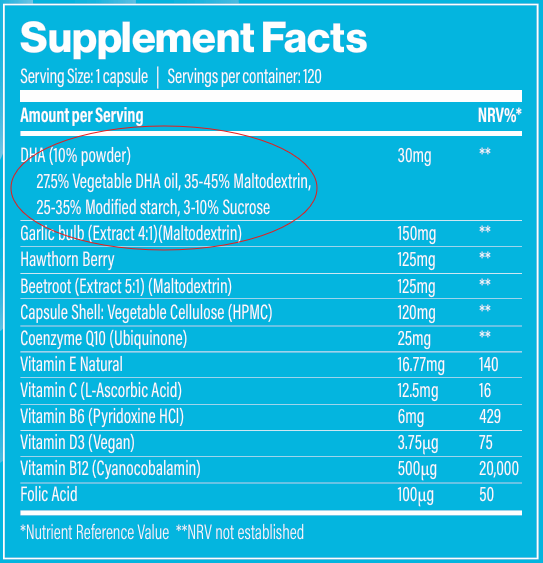
Brands typically don’t include small amounts of carrier compounds, most often maltodextrin, on the label for a capsule product. Functional ingredients such as magnesium oxide included in a buffered magnesium bisglycinate, must be included, as there is no legal justification for excluding them. When the product is a loose powder format, typically all compound ingredients should be listed, except in flavour powders. Many brands are not entirely honest about this- even the the ones who’s labels claim to always list everything, are often hiding compound ingredients.
This is a complex area with a lot of “if this, then that” rules, so we strongly recommend speaking to us rather than getting your answers online.
What do you mean “compound” ingredients?
Compound ingredients refers to any ingredient within an ingredient. For example many powder extracts contain maltodextrin as a carrying agent, or silica, to help keep the product dry. When D3 is used in a dry format such as a capsule or tablet, the D3 itself (which in it’s natural form is an oil) has to be spray dried onto a powder, typically maltodextrin, otherwise it would be impossible to mix with powder. Therefore, compound ingredients are common, and need to be carefully handled.
There are also functional compound ingredients - the most common is magnesium oxide, which is added to other forms of magnesium to allow brands to inflate their label claims. As the magnesium oxide is an active ingredient, brands who leave this out are at risk of challenge from regulatory bodies.
So what are the laws regarding showing compound ingredients on the label?
The carry over principle as per the Food Information for Consumers Regulation Article 20 states that the following may be omitted from the ingredients list if the stated conditions are true:
food additives and food enzymes:
(i) whose presence in a given food is solely due to the fact that they were contained in one or more ingredients of that food, in accordance with the carry-over principle referred to in points (a) and (b) of Article 18(1) of Regulation (EC) No 1333/2008, provided that they serve no technological function in the finished product;
or
(ii) which are used as processing aids;
(c) carriers and substances which are not food additives but are used in the same way and with the same purpose as carriers, and which are used in the quantities strictly necessary;
(d) substances which are not food additives but are used in the same way and with the same purpose as processing aids and are still present in the finished product, even if in an altered form.
So why do capsules and powders have different rules?
Because a carrier in an ingredient, when included in the capsule, is no longer serving a technological function. However, in a powder, the carrier is still carrying, and thus is serving a technological function and would need declaring.
Can I leave the compound ingredients for Vitamin D3 and K2 off the label?
These do come a lot, as the most common ingredients in supplements that have compound ingredients. In most cases, when included at supplemental levels, the compound ingredients for Vitamin D3 and Vitamin K2 can be left off a UK label, on the basis that A. they are included in very small, sub 2% quantities in the final weight of the product, and B. They serve no technological function in the finished product. If you intend a D3 product at higher than 4000iu, this could change, and you should speak to us to discuss the label.
Can I leave the compound ingredients for Vitamin E and Vitamin A off the label?
This depends on the quantities, and the exact compound ingredients your produced uses. It’s less straight forward than Vitamins D3 and K2, because you are likely to be using higher quantities, and some compounds in vitamin E could be holding a technological function. Vitamin A can be toxic in higher doses, and also needs careful treatment on the label. We would typically suggest reaching out to us to discuss the product.
Not sure you’ve understood?
This is a complex subject. We would always recommend speaking to us for expert advice around your exact product to ensure you get your label right.